Ein echter Reitschuster-Volltreffer

„Der Staat ist nicht die Lösung,
der Staat selbst ist das Problem“
Was Sie nach dem Willen deutscher
Medien nicht erfahren sollen
Von Kai
Rebmann
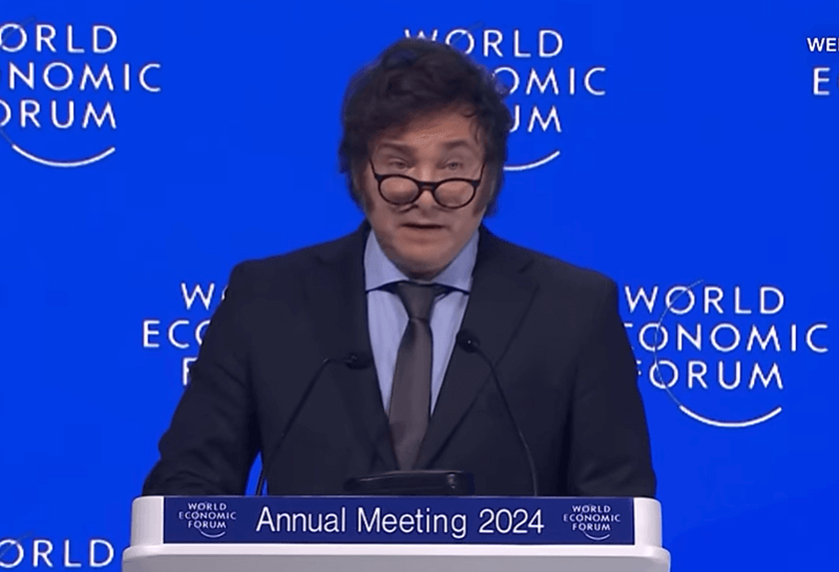
Javier Milei war noch gar nicht in Davos und sorgte dennoch schon für
Gesprächsstoff. Der neue Präsident Argentiniens machte nämlich genau das, was
Bundesaußenministerin Annalena Baerbock bei ihrem Amtsantritt noch großspurig
angekündigt hatte, dann aber keine Taten folgen ließ – er flog Linie von Buenos
Aires via Frankfurt nach Zürich. Diese Art der Anreise habe seinem Land
umgerechnet 392.000 US-Dollar gespart, rechnete Milei auf X vor.
Bereits bei seiner Zwischenlandung in Deutschland machte der Libertäre
klar, dass er nicht gekommen ist, um in den
eintönigen Chor der vermeintlichen Weltverbesserer unter dem Dirigenten Klaus
Schwab einzustimmen: „Ich möchte die Ideen
der Freiheit in einem sozialistischen Forum verankern, das von der Agenda 2030
kontaminiert ist.“
Sozialismus bedroht die Weltwirtschaft
Es ist fast schon erstaunlich, dass man Milei
auf dem Weltwirtschaftsforum überhaupt hat reden lassen. Ist das WEF doch
bekannt dafür, dass dessen Protagonisten für eine
globale Transformation unter der Kontrolle einer wie auch immer gearteten
staatlichen Institution einstehen – also ziemlich genau für das Gegenteil, von
dem was der Südamerikaner anstrebt, der stets die individuelle Freiheit in den
Vordergrund stellt.
Aus eben diesem Grund darf es auch nicht überraschen, dass
der Auftritt von Javier Milei in den hiesigen Mainstream-Medien entweder
überhaupt nicht stattfand oder allenfalls am Rande bzw. im Kleingedruckten
erwähnt wurde. Oder wahlweise in völlig sinnentstellender Weise, wie
hier bei der „Welt“.
Auge in Auge mit den politischen und wirtschaftlichen Führern dieser Welt
richtete der argentinische Präsident eine eindringliche Warnung an seine
Zuhörer. Die Weltwirtschaft, und insbesondere der Westen, sei in Gefahr, so
Milei, „weil diejenigen, die westliche Werte
verteidigen sollen, von einer Weltanschauung vereinnahmt werden, die
unaufhaltsam in den Sozialismus und damit in die Armut führt“.
Kollektivistische Experimente seien niemals die Lösung für die Probleme,
die die Bürger plagen, sondern vielmehr deren Ursache. Oder im Umkehrschluss formuliert: „Weit
davon entfernt, die Ursache unserer Probleme zu sein, ist das Wirtschaftssystem
des Kapitalismus des freien Unternehmertums das einzige uns zur Verfügung
stehende Mittel, um Hunger, Armut und Obdachlosigkeit auf der ganzen Welt zu
beenden. Die empirischen Beweise sind unbestreitbar.“
Tatsächlich findet sich in der Geschichte kein einziges Beispiel dafür,
in dem der Sozialismus langfristig zu breitem gesellschaftlichem Wohlstand und
Frieden geführt hätte. Und als Argentinier, aber auch Südamerikaner, weiß Milei
besser als die meisten seiner Zuhörer in Davos, wovon er in diesem Zusammenhang
spricht.
Kampfansage an die ‚soziale
Gerechtigkeit‘
Den Kapitalismus bezeichnete Milei als das „einzige moralisch wünschenswerte System“, und begründete auch, weshalb
er dieser Ansicht ist: „Der Kapitalismus ist gerecht und moralisch überlegen.
Seine Umsetzung hat dazu geführt, dass die Welt
reicher, freier, friedlicher und wohlhabender ist als jemals zuvor in der
Geschichte.“
Und weiter: „Die linke Doxa hat den
Kapitalismus aus moralischen Gründen angegriffen, weil seine Kritiker ihn als
ungerecht empfinden. Sie behaupten, der Kapitalismus sei schlecht, weil er
individualistisch sei, der Kollektivismus aber gut sei, weil er altruistisch sei.
Und deshalb kämpfen sie für soziale Gerechtigkeit.“
Der Präsident bezeichnet diese „soziale
Gerechtigkeit“ aber nicht nur als „nicht gerecht“, sondern sogar als
„gewalttätig“ („violenta“), was in
diesem Zusammenhang wohl am Ehesten im Sinne von „Zwang“ zu verstehen ist. Die
Idee der sozialen Gerechtigkeit sei in Wirklichkeit aber ungerecht, weil sie
durch den Staat finanziert werde: „Durch Steuern und diese Steuern werden zwangsweise
erhoben. Oder kann sich jemand von uns frei entscheiden, keine Steuern zu
zahlen? Das bedeutet, dass der Staat durch Zwang finanziert
wird und dieser Zwang umso größer ausfällt, je höher
die Steuerlast ist.“
Im Klartext: Javier Milei sagt an dieser Stelle, wenn auch auf nicht sehr
populäre Art und Weise, nichts anderes, als dass am
Ende des Tages (fast) jeder seines eigenen Glückes Schmids sein kann. Das
Problem für die Mächtigen am WEF in Davos ist hingegen: Nur Bürger, die – mehr oder weniger – vom Staat abhängig
sind, sind in ihren Augen auch „gute“ Bürger.
‚Es lebe die Freiheit‘
Die Situation der westlichen Welt beschreibt der ungehobelte Gast am WEF
so: „Ich sage, dass
der Westen in Gefahr ist, gerade weil in den Ländern, die die Werte der freien
Marktwirtschaft, des Privateigentums und weiterer Institutionen des
Libertarismus verteidigen sollten, Kreise des politischen und wirtschaftlichen
Establishments – einige aufgrund von falschen Annahmen, andere aufgrund von
Machtstreben – die Grundlagen des Libertarismus untergraben und damit dem
Sozialismus die Tür öffnen und damit den Weg in Armut, Elend und Stagnation
ebnen.“
Dass die Wahrheit manchmal nur schwer zu ertragen ist, machte Milei in seinem
nächsten Punkt deutlich:
„Das Grausamste an der
Umweltagenda ist, dass reiche Länder, die durch die
legitime Ausbeutung ihrer natürlichen Ressourcen reich geworden sind, jetzt
versuchen, ärmere Länder für ihre Schuld büßen zu lassen, indem sie diese daran
hindern, ihre Wirtschaft durch ein angebliches Verbrechen zu fördern, das sie
selbst begangen haben.“
Und weiter: „Wir sind hier, um die
Länder des Westens einzuladen, auf den Weg der Freiheit zurückzukehren. Lassen
Sie sich nicht von der politischen Kaste und den Parasiten einschüchtern, die
auf Kosten des Staates leben.“
Am Beispiel Argentiniens skizzierte der Präsident, welche Konsequenzen es
seiner Meinung nach hat, wenn die Grundwerte des Libertarismus über Bord
geworfen werden: „Sobald Maßnahmen ergriffen
werden, die das Funktionieren der freien Marktwirtschaft, den freien
Wettbewerb, freie Preisbildung behindern; wenn der Handel behindert wird, wenn
Privateigentum angetastet wird, dann ist die Armut das einzig mögliche Schicksal.“
Javier Milei schloss seine Rede in der Schweiz
mit dem Satz, der ihm schon im Wahlkampf zum Mantra geworden war: „Es lebe die Freiheit – verdammt nochmal!“
Bemerkenswertes Detail am Rande: Während die Rede des Argentiniers bei
den Anwesenden in Davos fast schon demonstrativ mit
vergleichsweise wenig Applaus bedacht wurde, fiel die Reaktion in den
sozialen Medien – also beim „Pöbel“ – ganz anders aus. Mehrere
spanischsprachige Medien berichten, dass der Auftritt
Mileis am WEF bis zu 40-mal so oft angeschaut wurde als jener von Pedro Sánchez
(PSOE), dem sozialistischen Ministerpräsident Spaniens.
Siehe auch: https://www.libremercado.com/2024-01-18/milei-humilla-a-sanchez-su-discurso-es-visto-40-veces-mas-7088146/
Auf Ihre Mithilfe kommt es an!
Reitschuster.de: „Auf meiner Seite
konnten Sie schon 2021 lesen, was damals noch als „Corona-Ketzerei“ galt – und
heute selbst von den großen Medien eingestanden werden muß. Kritischer
Journalismus ist wie ein Eisbrecher – er schlägt Schneisen in die Einheitsmeinung.“
Dafür muß man einiges aushalten. Aber
nur so bricht man das Eis. Langsam, aber sicher.
Mit Dank an Kai Rebmann und Boris
Reitschuster
https://reitschuster.de/post/der-staat-ist-nicht-die-loesung-der-staat-selbst-ist-das-problem/
The weekend story
A real riding Reitschuster hit
“The state is not the solution,
the state itself is the problem.”
What the German media doesn't want you to know
By
Kai Rebmann
Javier Milei
hadn't even been to Davos yet and was already a topic of conversation. The new President
of Argentina did exactly what Federal Foreign Minister Annalena Baerbock had
grandly announced when she took office, but then did not follow up with action
- he flew from Buenos Aires via Frankfurt to Zurich. Milei calculated that this
type of travel saved his country the equivalent of $392,000.
Already during
his stopover in Germany, the libertarian made it clear that he had not come to
join the monotonous chorus of supposed do-gooders led by conductor Klaus
Schwab: “I want to
anchor the ideas of freedom in a socialist forum that is guided by the 2030
Agenda is contaminated.”
Socialism
threatens the global economy
It's almost
astonishing that Milei was even allowed to speak at the World Economic Forum.
The WEF is known for the fact that its protagonists stand for a global
transformation under the control of some kind of state institution - pretty
much the opposite of what the South American strives for, who always puts
individual freedom in the foreground.
For precisely
this reason, it should come as no surprise that Javier Milei's appearance in
the local mainstream media either did not take place at all or was only
mentioned in passing or in small print. Or alternatively in a way that
completely distorts the meaning, as here with the “world”.
Face to face
with the world's political and economic leaders, the Argentine president issued
a strong warning to his listeners. The global economy, and especially the West,
is in danger, said Milei, “because
those who are supposed to defend Western values are being captured by a
worldview that leads inexorably to socialism and thus to poverty.”
Collectivist experiments
are never the solution to the problems that plague citizens, but rather the
cause of them. Or to put it the other way round: “Far from being the cause of our
problems, the economic system of free enterprise capitalism is the only means
available to us to end hunger, poverty and homelessness around the world. The
empirical evidence is undeniable.”
In fact, there
is not a single example in history in which socialism has led to widespread
social prosperity and peace in the long term. And as an Argentinian, but also a
South American, Milei knows better than most of his listeners in Davos what he
is talking about in this context.
Declaration
of war on 'social justice'
Milei
described capitalism as the “only morally desirable system,” and also
explained why he believes this: “Capitalism is just and morally superior. Its
implementation has resulted in the world being richer, freer, more peaceful and
more prosperous than ever before in history.”
And further: “The left Doxa has attacked
capitalism on moral grounds because its critics find it unfair. They claim that
capitalism is bad because it is individualistic, but collectivism is good
because it is altruistic. And that’s why they fight for social justice.”
The president
describes this “social
justice” not only as “not fair”, but even as “violent” (“violenta”),
which in this context is probably best understood in the sense of “coercion”. In reality, the idea of social justice is unjust because it
is financed by the state: “Through
taxes and these taxes are collected compulsorily. Or can any of us freely
choose not to pay taxes? This means that the state is financed through coercion
and this coercion becomes greater the higher the tax burden is.”
In plain
language: Javier Milei is saying at this point, albeit in a not very popular
way, nothing other than that at the end of the day (almost) everyone can be Schmids of their own happiness. The problem for those in power at
the WEF in Davos, however, is that only citizens who are –
more or less – dependent on the state are, in their eyes, “good”
citizens.
,Long live freedom'
The uncouth
guest at the WEF describes the situation in the Western world as follows: “I say that the West is in danger precisely
because in the countries that should defend the values of the free market
economy, private property and other institutions of libertarianism, there are
political circles and economic establishments – some based on false
assumptions, others based on a desire for power – undermine the foundations of
libertarianism and thereby open the door to socialism, paving the way to
poverty, misery and stagnation.”
Milei made it
clear in his next point that the truth is sometimes difficult to bear:
“The
cruelest thing about the environmental agenda is that rich countries, which
have become rich through the legitimate exploitation of their natural
resources, are now trying to make poorer countries pay for their guilt by
preventing them from promoting their economies through an alleged crime, which
they themselves committed.”
And further: “We are here to invite the countries
of the West to return to the path of freedom. Do not be intimidated by the
political caste and the parasites who live at the expense of the state.”
Using
Argentina as an example, the President outlined the consequences, in his
opinion, of throwing the basic values of libertarianism overboard: “As soon as measures are taken that
hinder the functioning of the free market economy, free competition, free
pricing; if trade is hindered, if private property is violated, then poverty is
the only possible fate.”
Javier Milei
concluded his speech in Switzerland with the sentence that had already become
his mantra during the election campaign: “Long live freedom – damn it!”
Remarkable
detail on the side: While the Argentine's speech was greeted with comparatively
little applause by those present in Davos, the reaction on social media - i.e.
among the "rabble" - was completely different. Several
Spanish-language media outlets report that Milei's appearance at the WEF was
viewed up to 40 times as often as that of Pedro Sánchez (PSOE), Spain's
socialist prime minister.
Your help is important!
Reitschuster.de:
“On my site you were able to read as early as 2021 what was still considered a
“Corona heresy” at the time - and which today even the major media has to admit. Critical journalism is like an icebreaker – it
cuts a path through the consensus of opinion.”
You
have to endure a lot for that. But that's the only way
to break the ice. Slowly but surely.
With
thanks to Kai Rebmann and Boris Reitschuster
https://reitschuster.de/post/der-staat-ist-nicht-die-loesung-der-staat-selbst-ist-das-problem/
Meridian
Note: Due to lack of time, only an automatic translation
This is a transcript from the Special address by Javier
Milei, President of Argentina, which took place during the World Economic
Forum’s Annual Meeting in Davos.
Good
afternoon. Thank you very much.
Today I’m here
to tell you that the Western world is in danger. And it is in danger because
those who are supposed to have to defend the values of the West are co-opted by
a vision of the world that inexorably leads to socialism and thereby to
poverty.
Unfortunately,
in recent decades, the main leaders of the Western world have abandoned the
model of freedom for different versions of what we call collectivism. Some have
been motivated by well-meaning individuals who are willing to help others, and
others have been motivated by the wish to belong to a privileged caste.
We’re here to
tell you that collectivist experiments are never the solution to the problems
that afflict the citizens of the world. Rather, they are the root cause. Do
believe me: no one is in better place than us, Argentines, to testify to these
two points.
Thirty
five years after
we adopted the model of freedom, back in 1860, we became a leading world power.
And when we embraced collectivism over the course of the last 100 years, we saw
how our citizens started to become systematically impoverished, and we dropped
to spot number 140 globally.
But before
having the discussion, it would first be important for us to take
a look at the data that demonstrate why free
enterprise capitalism is not just the only possible system to end world
poverty, but also that it’s the only morally desirable system to achieve this.
If we look at
the history of economic progress, we can see how between the year zero and the
year 1800 approximately, world per capita GDP practically remained constant
throughout the whole reference period.
If you look at
a graph of the evolution of economic growth throughout the history of humanity,
you would see a hockey stick graph, an exponential
function that remained constant for 90 per cent of the time and which was
exponentially triggered starting in the 19th century.
The only
exception to this history of stagnation was in the late 15th century, with the
discovery of the American continent, but for this exception, throughout the
whole period between the year zero and the year 1800, global per capita GDP
stagnated.
Now, it’s not
just that capitalism brought about an explosion in wealth from the moment it
was adopted as an economic system, but also, if you look at the data, what you
will see is that growth continues to accelerate throughout the whole period.
And throughout
the whole period between the year zero and the year 1800, the per capita GDP
growth rate remains stable at around 0.02 per cent annually. So almost no
growth. Starting in the 19th century with the Industrial Revolution, the
compound annual growth rate was 0.66 per cent. And at that rate, in order to double per capita GDP, you would need some 107
years.
Now, if you look
at the period between the year 1900 and the year 1950, the growth rate
accelerated to 1.66 per cent a year. So you no longer
need 107 years to double per capita GDP — but 66. And if you take the period
between 1950 and the year 2000, you will see that the growth rate was 2.1 per
cent, which would mean that in only 33 years we could double the world’s per
capita GDP.
This trend,
far from stopping, remains well alive today. If we take the period between the
years 2000 and 2023, the growth rate again accelerated to three per cent a
year, which means that we could double world per capita GDP in just 23 years.
That said,
when you look at per capita GDP since the year 1800 until today, what you will
see is that after the Industrial Revolution, global per capita GDP multiplied
by over 15 times, which meant a boom in growth that lifted 90 per cent of the
global population out of poverty.
We should
remember that by the year 1800, about 95 per cent of the world’s population
lived in extreme poverty. And that figure dropped to five per cent by the year
2020, prior to the pandemic. The conclusion is obvious.
Far from being
the cause of our problems, free trade capitalism as an economic system is the
only instrument we have to end hunger, poverty and extreme poverty across our
planet. The empirical evidence is unquestionable.
Therefore since there is no doubt that free
enterprise capitalism is superior in productive terms, the left-wing doxa has
attacked capitalism, alleging matters of morality, saying — that’s what the
detractors claim — that it’s unjust. They say that capitalism is evil because
it’s individualistic and that collectivism is good because it’s altruistic. Of
course, with the money of others.
So they therefore advocate for social
justice. But this concept, which in the developed world became fashionable in
recent times, in my country has been a constant in political discourse for over
80 years. The problem is that social justice is not just, and it doesn’t
contribute to general well-being.
Quite on the
contrary, it’s an intrinsically unfair idea because it’s violent. It’s unjust
because the state is financed through tax and taxes are collected coercively.
Or can any one of us say that we voluntarily pay taxes? This means that the
state is financed through coercion and that the higher the tax burden, the
higher the coercion and the lower the freedom.
Those who
promote social justice start with the idea that the whole economy is a pie that
can be shared differently. But that pie is not a given. It’s wealth that is
generated in what Israel Kirzner, for instance, calls a market discovery
process.
If the goods
or services offered by a business are not wanted, the business will fail unless
it adapts to what the market is demanding. They will do well and produce more
if they make a good quality product at an attractive price. So
the market is a discovery process in which the capitalists will find the right
path as they move forward.
But if the
state punishes capitalists when they’re successful and gets in the way of the
discovery process, they will destroy their incentives, and the consequence is
that they will produce less.
The pie will
be smaller, and this will harm society as a whole.
Collectivism, by inhibiting these discovery processes and hindering the
appropriation of discoveries, ends up binding the hands of entrepreneurs and
prevents them from offering better goods and services at a better price.
So how come
academia, international organizations, economic theorists and politicians
demonize an economic system that has not only lifted 90 per cent of the world’s
population out of extreme poverty but has continued to do this faster and faster?
Thanks to free
trade capitalism, the world is now living its best moment. Never in all of
mankind or humanity’s history has there been a time of more prosperity than
today. This is true for all. The world of today has more freedom, is rich, more
peaceful and prosperous. This is particularly true for countries that have more
economic freedom and respect the property rights of individuals.
Countries that
have more freedom are 12 times richer than those that are repressed. The lowest
percentile in free countries is better off than 90 per cent of the population
in repressed countries. Poverty is 25 times lower and extreme poverty is 50
times lower. And citizens in free countries live 25 per cent longer than
citizens in repressed countries.
Now what is it
that we mean when we talk about libertarianism? And let me quote the words of
the greatest authority on freedom in Argentina, Professor Alberto Benegas Lynch
Jr, who says that libertarianism is the unrestricted respect for the life
project of others based on the principle of non-aggression, in defence of the right to life, liberty and property.
Its
fundamental institutions are private property, markets free from state
intervention, free competition, and the division of labour
and social cooperation, in which success is achieved only by serving others
with goods of better quality or at a better price.
In other
words, capitalist successful business people are
social benefactors who, far from appropriating the wealth of others, contribute
to the general well-being. Ultimately, a successful entrepreneur is a hero.
And this is
the model that we are advocating for the Argentina of the future. A model based
on the fundamental principle of libertarianism. The defence
of life, of freedom and of property.
Now, if the free enterprise, capitalism and economic freedom have
proven to be extraordinary instruments to end poverty in the world, and we are
now at the best time in the history of humanity, it is worth asking why I say
that the West is in danger.
And I say this
precisely because in countries that should defend the values of the free
market, private property and the other institutions of libertarianism, sectors
of the political and economic establishment are
undermining the foundations of libertarianism, opening up
the doors to socialism and potentially condemning us to poverty, misery and
stagnation.
It should
never be forgotten that socialism is always and everywhere an impoverishing
phenomenon that has failed in all countries where it’s been tried out. It’s
been a failure economically, socially, culturally and it also murdered over 100
million human beings.
The essential
problem of the West today is not just that we need to come to grips with those
who, even after the fall of the Berlin Wall and the overwhelming empirical
evidence, continue to advocate for impoverishing socialism.
But there’s
also our own leaders, thinkers and academics who are relying on a misguided
theoretical framework to undermine the fundamentals of the system that has
given us the greatest expansion of wealth and prosperity in our history.
The
theoretical framework to which I refer is that of Neoclassical economic theory,
which designs a set of instruments that, unwillingly or without meaning to, end
up serving intervention by the state, socialism and social degradation.
The problem
with Neoclassicals is that the model they fell in love with does not map
reality, so they put down their mistakes to supposed market failures rather
than reviewing the premises of the model.
Under the
pretext of a supposed market failure, regulations are introduced. These
regulations create distortions in the price system, prevent economic calculus,
and therefore also prevent saving, investment and growth.
This problem lies
mainly in the fact that not even supposed libertarian economists understand
what the market is because if they did understand, it would quickly be seen
that it’s impossible for there to be market failures.
The market is
not a mere graph describing a curve of supply and demand. The market is a
mechanism for social cooperation, where you voluntarily exchange ownership
rights. Therefore based on this definition, talking
about a market failure is an oxymoron. There are no market failures.
If
transactions are voluntary, the only context in which there can be market
failure is if there is coercion and the only one that is able to coerce
generally is the state, which holds a monopoly on violence.
Consequently,
if someone considers that there is a market failure, I would
suggest that they check to see if there is state intervention involved.
And if they find that that’s not the case, I would suggest
that they check again, because obviously there’s a mistake. Market failures do
not exist.
An example of
the so-called market failures described by the Neoclassicals is the
concentrated structure of the economy. From the year 1800 onwards, with the
population multiplying by eight or nine times, per capita GDP grew by over 15
times, so there were growing returns which took extreme poverty from 95 per
cent to five per cent.
However, the
presence of growing returns involves concentrated structures, what we would
call a monopoly. How come, then, something that has generated so much
well-being for the Neoclassical theory is a market failure?
Neoclassical
economists think outside of the box. When the model fails, you shouldn’t get
angry with reality but rather with a model and change it. The dilemma faced by
the Neoclassical model is that they say they wish to perfect the function of
the market by attacking what they consider to be failures. But in so doing,
they don’t just open up the doors to socialism but
also go against economic growth.
For example,
regulating monopolies, destroying their profits and destroying growing returns
would automatically destroy economic growth.
However, faced
with the theoretical demonstration that state intervention is harmful — and the
empirical evidence that it has failed couldn’t have been otherwise — the
solution proposed by collectivists is not greater freedom but rather greater
regulation, which creates a downward spiral of regulations until we are all
poorer and our lives depend on a bureaucrat sitting in a luxury office.
Given the
dismal failure of collectivist models and the undeniable advances in the free
world, socialists were forced to change their agenda: they left behind the
class struggle based on the economic system and replaced this with other
supposed social conflicts, which are just as harmful to life and to economic
growth.
The first of
these new battles was the ridiculous and unnatural fight between man and woman.
Libertarianism already provides for equality of the sexes. The cornerstone of
our creed is that all humans are created equal and
that we all have the same inalienable rights granted by the Creator, including
life, freedom and ownership.
All that the
radical feminism agenda has led to is greater state intervention to hinder
economic process, giving jobs to bureaucrats who have not contributed anything
to society. Examples are ministries of women or international organizations
devoted to promoting this agenda.
Another
conflict presented by socialists is that of humans against nature, claiming
that we human beings damage a planet which should be protected at all costs,
even going as far as advocating for population control mechanisms or the
abortion agenda.
Unfortunately,
these harmful ideas have taken a stronghold in our society. Neo-Marxists have
managed to co-opt the common sense of the Western world, and this
they have achieved by appropriating the media, culture, universities and also international organizations.
The latter
case is the most serious one, probably because these are institutions that have
enormous influence on the political and economic decisions of their member
states.
Fortunately there’s more and
more of us who are daring to make our voices heard, because we see that
if we don’t truly and decisively fight against these ideas, the only possible
fate is for us to have increasing levels of state regulation, socialism,
poverty and less freedom, and therefore, worse standards of living.
The West has
unfortunately already started to go along this path. I know, to many it may
sound ridiculous to suggest that the West has turned to socialism, but it’s
only ridiculous if you only limit yourself to the traditional economic
definition of socialism, which says that it’s an economic system where the
state owns the means of production. This definition in my view, should be
updated in the light of current circumstances.
Today, states
don’t need to directly control the means of production to control every aspect
of the lives of individuals. With tools such as printing money, debt,
subsidies, controlling the interest rate, price controls, and regulations to
correct so-called market failures, they can control the lives and fates of
millions of individuals.
This is how we
come to the point where, by using different names or guises, a good deal of the
generally accepted ideologies in most Western countries are collectivist
variants, whether they proclaim to be openly communist, fascist, socialist,
social democrats, national socialists, Christian democrats, neo-Keynesians,
progressives, populists, nationalists or globalists.
Ultimately,
there are no major differences. They all say that the state should steer all
aspects of the lives of individuals. They all defend a model contrary to the
one that led humanity to the most spectacular progress in its history.
We have come
here today to invite the Western world to get back on the path to prosperity.
Economic freedom, limited government and unlimited respect for private property
are essential elements for economic growth. The impoverishment produced by
collectivism is not a fantasy, nor is it an inescapable fate. It’s a reality
that we Argentines know very well.
We have lived
through this. We have been through this because, as I said earlier, ever since
we decided to abandon the model of freedom that had made us rich, we have been
caught up in a downward spiral – a spiral by which we are poorer and poorer,
day by day.
This is
something we have lived through and we are here to
warn you about what can happen if countries in the Western world, that became rich through the model of freedom, stay on this path
of servitude.
The case of
Argentina is an empirical demonstration that no matter how rich you may be, how
much you may have in terms of natural resources, how skilled your population
may be, how educated, or how many bars of gold you may have in the central bank
— if measures are adopted that hinder the free functioning of markets,
competition, price systems, trade and ownership of private property, the only
possible fate is poverty.
Therefore, in
conclusion, I would like to leave a message for all business
people here and those who are not here in person but are following from
around the world.
Do not be
intimidated by the political caste or by parasites who live off the state. Do
not surrender to a political class that only wants to stay in power and retain
its privileges. You are social benefactors. You are heroes. You are the
creators of the most extraordinary period of prosperity we’ve ever seen.
Let no one
tell you that your ambition is immoral. If you make money, it’s because you
offer a better product at a better price, thereby contributing to general
wellbeing.
Do not surrender
to the advance of the state. The state is not the solution. The state is the
problem itself. You are the true protagonists of this story and rest assured
that as from today, Argentina is your staunch and unconditional ally.
Thank you very
much and long live freedom!
Dies ist eine Abschrift der Sonderansprache des argentinischen
Präsidenten Javier Milei,
die während der Jahrestagung des Weltwirtschaftsforums in Davos gehalten
wurde.
https://nationalpost.com/opinion/read-javier-mileis-entire-speech-to-the-wef-debunking-socialism
Guten Tag. Vielen Dank.
Heute möchte ich Ihnen sagen, dass die westliche Welt in Gefahr ist. Und es ist in
Gefahr, weil diejenigen, die die Werte des Westens verteidigen sollen, von
einer Weltanschauung vereinnahmt werden, die unaufhaltsam zum Sozialismus und
damit zur Armut führt.
Leider haben die wichtigsten Führer
der westlichen Welt in den letzten Jahrzehnten das Modell der Freiheit
zugunsten verschiedener Versionen dessen aufgegeben, was wir Kollektivismus
nennen. Einige wurden von wohlmeinenden Menschen motiviert, die bereit sind,
anderen zu helfen, und andere wurden von dem Wunsch motiviert, einer
privilegierten Kaste anzugehören.
Wir sind hier, um Ihnen zu sagen, dass kollektivistische Experimente niemals die Lösung für
die Probleme sind, die die Bürger der Welt plagen. Sie sind vielmehr die
Grundursache. Glauben Sie mir: Niemand ist besser in der Lage als wir
Argentinier, diese beiden Punkte zu bezeugen.
35 Jahre nachdem wir 1860 das Modell
der Freiheit übernommen hatten, wurden wir zu einer führenden Weltmacht. Und
als wir uns im Laufe der letzten 100 Jahre dem Kollektivismus zuwandten, sahen
wir, wie unsere Bürger systematisch zu verarmen begannen, und wir fielen
weltweit auf Platz 140 zurück.
Aber bevor wir die Diskussion
beginnen, wäre es für uns zunächst wichtig, einen Blick auf die Daten zu
werfen, die zeigen, warum der Kapitalismus des freien Unternehmertums nicht nur
das einzig mögliche System zur Beendigung der weltweiten Armut ist, sondern
auch, dass es das einzig moralisch wünschenswerte
System ist, um dies zu erreichen .
Wenn wir uns die Geschichte des
wirtschaftlichen Fortschritts ansehen, können wir sehen, dass
das weltweite Pro-Kopf-BIP zwischen dem Jahr Null und etwa dem Jahr 1800
während des gesamten Referenzzeitraums praktisch konstant blieb.
Wenn Sie sich ein Diagramm der Entwicklung
des Wirtschaftswachstums im Laufe der Menschheitsgeschichte ansehen, sehen Sie
ein Hockeyschlägerdiagramm, eine Exponentialfunktion, die 90 Prozent der Zeit
konstant blieb und ab dem 19. Jahrhundert exponentiell ausgelöst wurde.
Die einzige Ausnahme von dieser
Geschichte der Stagnation war im späten 15. Jahrhundert mit der Entdeckung des
amerikanischen Kontinents, aber für diese Ausnahme stagnierte das globale
Pro-Kopf-BIP während des gesamten Zeitraums zwischen dem Jahr Null und dem Jahr
1800.
Nun ist es nicht nur so, dass der Kapitalismus von dem Moment an, als er als
Wirtschaftssystem eingeführt wurde, zu einer Explosion des Wohlstands geführt
hat, sondern wenn man sich die Daten anschaut, wird man auch sehen, dass sich das Wachstum während des gesamten Zeitraums
weiter beschleunigt.
Und während des gesamten Zeitraums
zwischen dem Jahr Null und dem Jahr 1800 bleibt die Wachstumsrate des
Pro-Kopf-BIP stabil bei rund 0,02 Prozent pro Jahr. Also fast kein Wachstum. Ab
dem 19. Jahrhundert, mit der industriellen Revolution, betrug die durchschnittliche
jährliche Wachstumsrate 0,66 Prozent. Und bei diesem Tempo bräuchte man etwa
107 Jahre, um das Pro-Kopf-BIP zu verdoppeln.
Betrachtet man nun den Zeitraum
zwischen 1900 und 1950, so beschleunigte sich die Wachstumsrate auf 1,66
Prozent pro Jahr. Um das Pro-Kopf-BIP zu verdoppeln, braucht man also nicht
mehr 107 Jahre, sondern 66. Und wenn man sich den Zeitraum zwischen 1950 und
dem Jahr 2000 ansieht, sieht man, dass die
Wachstumsrate bei 2,1 Prozent lag, was bedeuten würde, dass
wir in nur 33 Jahren könnte das Pro-Kopf-BIP der Welt verdoppeln.
Dieser Trend ist weit davon entfernt,
aufzuhören, sondern ist auch heute noch lebendig. Wenn wir den Zeitraum
zwischen 2000 und 2023 betrachten, beschleunigt sich die Wachstumsrate erneut
auf drei Prozent pro Jahr, was bedeutet, dass wir das
weltweite Pro-Kopf-BIP in nur 23 Jahren verdoppeln könnten.
Wenn Sie sich jedoch das Pro-Kopf-BIP
seit dem Jahr 1800 bis heute ansehen, werden Sie feststellen, dass sich das globale Pro-Kopf-BIP nach der industriellen
Revolution um mehr als das Fünfzehnfache vervielfachte, was einen Wachstumsboom
bedeutete, der um 90 Prozent stieg die Weltbevölkerung
aus der Armut zu befreien.
Wir sollten uns daran erinnern, dass im Jahr 1800 etwa 95 Prozent der Weltbevölkerung in
extremer Armut lebten. Und dieser Wert sank bis zum Jahr 2020, also vor der
Pandemie, auf fünf Prozent. Die Schlussfolgerung
liegt auf der Hand.
Weit davon entfernt, die Ursache
unserer Probleme zu sein, ist der Freihandelskapitalismus als Wirtschaftssystem
das einzige Instrument, das uns zur Verfügung steht, um Hunger, Armut und
extreme Armut auf unserem Planeten zu beenden. Die empirischen Beweise sind
unbestreitbar.
Da es keinen Zweifel daran gibt, dass der Kapitalismus
des freien Unternehmertums in produktiver Hinsicht überlegen ist, hat die linke
Doxa den Kapitalismus angegriffen, indem sie Fragen der Moral vorgeworfen und
gesagt hat – das behaupten die Kritiker –, dass er
ungerecht sei. Sie sagen, dass der Kapitalismus böse
sei, weil er individualistisch sei, und dass der
Kollektivismus gut sei, weil er altruistisch sei. Natürlich mit dem Geld
anderer.
Deshalb setzen sie sich für soziale
Gerechtigkeit ein. Aber dieses Konzept, das in der entwickelten Welt in
jüngster Zeit in Mode gekommen ist, ist in meinem Land seit über 80 Jahren eine
Konstante im politischen Diskurs. Das Problem ist, dass
soziale Gerechtigkeit nicht gerecht ist und nicht zum allgemeinen Wohlergehen
beiträgt.
Ganz im Gegenteil, es ist eine an sich
unfaire Idee, weil sie gewalttätig ist. Es ist ungerecht, weil der Staat durch
Steuern finanziert wird und Steuern zwangsweise eingezogen werden. Oder kann
einer von uns sagen, dass wir freiwillig Steuern
zahlen? Das bedeutet, dass der Staat durch Zwang
finanziert wird und je höher die Steuerlast, desto höher der Zwang und desto
geringer die Freiheit.
Diejenigen, die sich für soziale
Gerechtigkeit einsetzen, gehen von der Vorstellung aus, dass
die gesamte Wirtschaft ein Kuchen ist, der auf unterschiedliche Weise geteilt
werden kann. Aber dieser Kuchen ist keine Selbstverständlichkeit. Es ist
Wohlstand, der in dem entsteht, was Israel Kirzner
beispielsweise einen Markterschließungsprozess nennt.
Wenn die von einem Unternehmen
angebotenen Waren oder Dienstleistungen nicht erwünscht sind, wird das
Unternehmen scheitern, wenn es sich nicht an die Anforderungen des Marktes anpasst. Sie werden erfolgreich sein und mehr produzieren,
wenn sie ein qualitativ hochwertiges Produkt zu einem attraktiven Preis
herstellen. Der Markt ist also ein Entdeckungsprozess,
in dem die Kapitalisten auf ihrem weiteren Weg den richtigen Weg finden.
Aber wenn der Staat Kapitalisten
bestraft, wenn sie erfolgreich sind, und den Entdeckungsprozess
behindert, zerstören sie ihre Anreize und die Konsequenz ist, dass sie weniger produzieren.
Der Kuchen wird kleiner, und das wird
der Gesellschaft als Ganzes schaden. Indem der Kollektivismus diese
Entdeckungsprozesse hemmt und die Aneignung von Entdeckungen behindert, fesselt
er letztendlich die Hände der Unternehmer und hindert sie daran, bessere Waren
und Dienstleistungen zu einem besseren Preis anzubieten.
Wie kommt es also, dass
Wissenschaftler, internationale Organisationen, Wirtschaftstheoretiker und
Politiker ein Wirtschaftssystem verteufeln, das nicht nur 90 Prozent der
Weltbevölkerung aus der extremen Armut befreit hat, sondern dies auch immer
schneller tut?
Dank des Freihandelskapitalismus
erlebt die Welt jetzt ihren besten Moment. Niemals in der gesamten
Menschheitsgeschichte gab es eine Zeit größeren Wohlstands als heute. Das gilt
für alle. Die Welt von heute hat mehr Freiheit, ist reicher, friedlicher und
wohlhabender. Dies gilt insbesondere für Länder, die mehr wirtschaftliche
Freiheit haben und die Eigentumsrechte des Einzelnen respektieren.
Länder mit mehr Freiheit sind zwölfmal
reicher als diejenigen, die unterdrückt werden. Dem untersten Perzentil in
freien Ländern geht es besser als 90 Prozent der Bevölkerung in unterdrückten
Ländern. Die Armut ist 25-mal geringer und die extreme Armut ist 50-mal
geringer. Und Bürger in freien Ländern leben 25 Prozent länger als Bürger in
unterdrückten Ländern.
Was meinen wir nun, wenn wir über
Libertarismus sprechen? Und lassen Sie mich die Worte der größten Autorität für
Freiheit in Argentinien, Professor Alberto Benegas
Lynch Jr., zitieren, der sagt, dass Libertarismus die
uneingeschränkte Achtung des Lebensentwurfs anderer auf der Grundlage des
Prinzips der Nichtaggression zur Verteidigung des Rechts auf Freiheit ist
Leben, Freiheit und Eigentum.
Seine grundlegenden Institutionen sind
Privateigentum, Märkte ohne staatliche Eingriffe, freier Wettbewerb sowie
Arbeitsteilung und soziale Zusammenarbeit, bei der Erfolg nur dadurch erzielt
wird, dass man anderen Waren von besserer Qualität
oder zu einem besseren Preis liefert.
Mit anderen Worten: Erfolgreiche
kapitalistische Geschäftsleute sind soziale Wohltäter, die weit davon entfernt
sind, sich den Reichtum anderer anzueignen, sondern zum allgemeinen Wohlergehen
beitragen. Letztendlich ist ein erfolgreicher Unternehmer ein Held.
Und das ist das Modell, das wir für
das Argentinien der Zukunft vertreten. Ein Modell, das auf dem Grundprinzip des
Libertarismus basiert. Die Verteidigung des Lebens, der Freiheit und des
Eigentums.
Wenn sich nun das freie
Unternehmertum, der Kapitalismus und die wirtschaftliche Freiheit als
außergewöhnliche Instrumente zur Beendigung der Armut in der Welt erwiesen
haben und wir uns jetzt im besten Zeitpunkt in der Geschichte der Menschheit
befinden, lohnt es sich zu fragen, warum ich sage, dass
der Westen dabei ist Gefahr.
Und ich sage das gerade deshalb, weil
in Ländern, die die Werte des freien Marktes, des Privateigentums und der
anderen Institutionen des Libertarismus verteidigen sollten, Teile des
politischen und wirtschaftlichen Establishments die Grundlagen des Libertarismus
untergraben, die Türen zum Sozialismus öffnen und möglicherweise verurteilen
uns in Armut, Elend und Stagnation.
Es darf nie vergessen werden, dass der Sozialismus immer und überall ein verarmendes
Phänomen ist, das in allen Ländern, in denen es versucht wurde, gescheitert
ist. Es war wirtschaftlich, sozial und kulturell ein Misserfolg
und hat auch über 100 Millionen Menschen ermordet.
Das wesentliche Problem des Westens
besteht heute nicht nur darin, dass wir uns mit denen
auseinandersetzen müssen, die auch nach dem Fall der Berliner Mauer und den
überwältigenden empirischen Beweisen weiterhin für einen verarmenden
Sozialismus eintreten.
Aber es gibt auch unsere eigenen
Führungskräfte, Denker und Akademiker, die sich auf einen fehlgeleiteten theoretischen
Rahmen verlassen, um die Grundlagen des Systems zu untergraben, das uns die
größte Ausweitung von Reichtum und Wohlstand in unserer Geschichte beschert
hat.
Der theoretische Rahmen, auf den ich
mich beziehe, ist der der neoklassischen Wirtschaftstheorie, die eine Reihe von
Instrumenten entwirft, die unfreiwillig oder unbeabsichtigt letztendlich der
Intervention des Staates, dem Sozialismus und dem sozialen Verfall dienen.
Das Problem mit Neoklassikern besteht
darin, dass das Modell, in das sie sich verliebt
haben, die Realität nicht abbildet. Deshalb führen sie ihre Fehler auf
angebliches Marktversagen zurück, anstatt die Prämissen des Modells zu
überprüfen.
Unter dem Vorwand eines vermeintlichen
Marktversagens werden Regulierungen eingeführt. Diese Regulierungen führen zu
Verzerrungen im Preissystem, verhindern wirtschaftliches Kalkül und verhindern
somit auch Sparen, Investitionen und Wachstum.
Dieses Problem liegt hauptsächlich
darin, dass nicht einmal vermeintlich libertäre
Ökonomen verstehen, was der Markt ist, denn wenn sie es verstehen würden, würde
man schnell erkennen, dass es unmöglich ist, dass es zu Marktversagen kommt.
Der Markt ist kein bloßes Diagramm,
das eine Kurve von Angebot und Nachfrage beschreibt. Der Markt ist ein
Mechanismus der sozialen Zusammenarbeit, bei dem man freiwillig Eigentumsrechte
austauscht. Basierend auf dieser Definition ist die Rede von einem Marktversagen
daher ein Widerspruch in sich. Es gibt kein Marktversagen.
Wenn Transaktionen freiwillig sind,
kann es nur dann zu Marktversagen kommen, wenn es Zwang gibt, und der einzige, der im Allgemeinen Zwang ausüben kann, ist der
Staat, der ein Gewaltmonopol innehat.
Wenn also jemand der Meinung ist, dass ein Marktversagen vorliegt, würde ich vorschlagen, dass er prüft, ob ein staatlicher Eingriff vorliegt. Und
wenn sie feststellen, dass das nicht der Fall ist,
würde ich vorschlagen, dass sie es noch einmal
überprüfen, denn offensichtlich liegt ein Fehler vor. Marktversagen gibt es
nicht.
Ein Beispiel für das von den
Neoklassikern beschriebene sogenannte Marktversagen ist die konzentrierte
Struktur der Wirtschaft. Ab dem Jahr 1800, als sich die Bevölkerung um das
Acht- bis Neunfache vervielfachte, wuchs das Pro-Kopf-BIP um mehr als das Fünfzehnfache,
was zu wachsenden Erträgen führte, die die extreme Armut von 95 Prozent auf
fünf Prozent senkten.
Das Vorhandensein steigender Renditen
erfordert jedoch konzentrierte Strukturen, was wir als Monopol bezeichnen
würden. Wie kommt es dann, dass etwas, das der
neoklassischen Theorie so viel Auftrieb gegeben hat, ein Marktversagen ist?
Neoklassische Ökonomen denken über den
Tellerrand hinaus. Wenn das Modell scheitert, sollte man sich nicht über die
Realität, sondern über ein Modell ärgern und es ändern. Das Dilemma des
neoklassischen Modells besteht darin, dass es sagt,
es wolle die Funktion des Marktes perfektionieren, indem es angreift, was
seiner Meinung nach gescheitert ist. Aber damit öffnen sie nicht nur die Türen
zum Sozialismus, sondern stehen auch dem Wirtschaftswachstum entgegen.
Beispielsweise würde die Regulierung
von Monopolen, die Zerstörung ihrer Gewinne und die Zerstörung wachsender
Erträge automatisch das Wirtschaftswachstum zerstören.
Angesichts des theoretischen
Nachweises, dass staatliche Eingriffe schädlich sind
– und der empirischen Beweise dafür, dass sie
gescheitert sind, hätte es nicht anders sein können – ist die von den
Kollektivisten vorgeschlagene Lösung jedoch nicht mehr Freiheit, sondern
vielmehr eine stärkere Regulierung, die eine Abwärtsspirale der Regulierungen
bis zum Ende schafft Wir sind alle ärmer und unser Leben hängt von einem
Bürokraten ab, der in einem Luxusbüro sitzt.
Angesichts des kläglichen Scheiterns kollektivistischer
Modelle und der unbestreitbaren Fortschritte in der freien Welt waren die
Sozialisten gezwungen, ihre Agenda zu ändern: Sie ließen den auf dem
Wirtschaftssystem basierenden Klassenkampf hinter sich und ersetzten ihn durch
andere vermeintliche soziale Konflikte, die für sie ebenso schädlich sind Leben
und Wirtschaftswachstum.
Der erste dieser neuen Kämpfe war der
lächerliche und unnatürliche Kampf zwischen Mann und Frau. Der Libertarismus
sieht bereits die Gleichstellung der Geschlechter vor. Der Eckpfeiler unseres
Glaubensbekenntnisses ist, dass alle Menschen gleich
geschaffen sind und dass wir alle die gleichen
unveräußerlichen Rechte haben, die der Schöpfer gewährt hat, einschließlich
Leben, Freiheit und Eigentum.
Die Agenda des radikalen Feminismus
hat lediglich dazu geführt, dass der Staat stärker
eingreift, um den wirtschaftlichen Prozess zu
behindern und Arbeitsplätze an Bürokraten zu vergeben, die nichts zur
Gesellschaft beigetragen haben. Beispiele sind Frauenministerien oder
internationale Organisationen, die sich der Förderung dieser Agenda widmen.
Ein weiterer Konflikt, den Sozialisten
präsentieren, ist der von Mensch und Natur. Sie behaupten, dass
wir Menschen einen Planeten schädigen, der um jeden Preis geschützt werden
sollte, und gehen sogar so weit, sich für Bevölkerungskontrollmechanismen oder
die Abtreibungsagenda einzusetzen.
Leider haben diese schädlichen Ideen
in unserer Gesellschaft Einzug gehalten. Den Neomarxisten ist es gelungen, den
gesunden Menschenverstand der westlichen Welt zu kooptieren, und zwar durch die
Aneignung der Medien, der Kultur, der Universitäten und auch internationaler
Organisationen.
Letzterer Fall ist der
schwerwiegendste, wahrscheinlich weil es sich um Institutionen handelt, die
enormen Einfluss auf die politischen und
wirtschaftlichen Entscheidungen ihrer Mitgliedstaaten haben.
Glücklicherweise gibt es immer mehr
von uns, die es wagen, ihrer Stimme Gehör zu verschaffen, denn wir sehen, dass, wenn wir diese Ideen nicht wirklich und entschieden
bekämpfen, das einzig mögliche Schicksal ein zunehmendes Maß an staatlicher
Regulierung, Sozialismus, Armut und weniger Freiheit und damit ein schlechterer
Lebensstandard.
Der Westen hat diesen Weg leider
bereits begonnen. Ich weiß, für viele mag es lächerlich klingen zu behaupten,
der Westen habe sich dem Sozialismus zugewandt, aber es ist nur lächerlich,
wenn man sich nur auf die traditionelle wirtschaftliche Definition des
Sozialismus beschränkt, die besagt, dass es sich um
ein Wirtschaftssystem handelt, in dem der Staat über die Mittel verfügt
Produktion. Diese Definition sollte meiner Ansicht nach angesichts der
aktuellen Umstände aktualisiert werden.
Heutzutage müssen Staaten die
Produktionsmittel nicht mehr direkt kontrollieren, um jeden Aspekt des Lebens
des Einzelnen zu kontrollieren. Mit Instrumenten wie dem Drucken von Geld,
Schulden, Subventionen, der Kontrolle des Zinssatzes, Preiskontrollen und
Vorschriften zur Korrektur sogenannter Marktversagen können sie das Leben und
Schicksal von Millionen Menschen kontrollieren.
So kommen wir an den Punkt, an dem ein
großer Teil der allgemein akzeptierten Ideologien in den meisten westlichen
Ländern durch die Verwendung unterschiedlicher Namen oder Verkleidungen
kollektivistische Varianten sind, unabhängig davon, ob sie sich offen als
kommunistisch, faschistisch, sozialistisch, sozialdemokratisch oder
nationalsozialistisch bezeichnen , Christdemokraten, Neokeynesianer, Progressive, Populisten, Nationalisten oder
Globalisten.
Letztlich gibt es keine großen
Unterschiede. Sie alle sagen, dass der Staat alle
Aspekte des Lebens des Einzelnen steuern sollte. Sie alle verteidigen ein
Modell, das im Gegensatz zu dem steht, das die
Menschheit zum spektakulärsten Fortschritt in ihrer Geschichte geführt hat.
Wir sind heute hierher
gekommen, um die westliche Welt einzuladen, wieder auf den Weg zum
Wohlstand zurückzukehren. Wirtschaftliche Freiheit, begrenzte Regierung und
uneingeschränkte Achtung des Privateigentums sind wesentliche Elemente für
Wirtschaftswachstum. Die durch den Kollektivismus hervorgerufene Verarmung ist
weder eine Fantasie noch ein unausweichliches Schicksal. Es ist eine Realität,
die wir Argentinier sehr gut kennen.
Wir haben das erlebt. Wir haben das
durchgemacht, weil wir, wie ich bereits sagte, seit wir beschlossen haben, das
Modell der Freiheit, das uns reich gemacht hat, aufzugeben, in einer
Abwärtsspirale gefangen sind – einer Spirale, durch die wir von Tag zu Tag
ärmer werden Tag.
Dies ist etwas, was wir erlebt haben,
und wir sind hier, um Sie davor zu warnen, was passieren kann, wenn Länder in
der westlichen Welt, die durch das Modell der Freiheit reich geworden sind, auf
diesem Weg der Knechtschaft bleiben.
Der Fall Argentinien ist ein
empirischer Beweis dafür, dass es egal ist, wie reich
Sie sind, wie viele natürliche Ressourcen Sie haben, wie qualifiziert Ihre
Bevölkerung sein mag, wie gebildet oder wie viele Goldbarren Sie im Zentrum
haben Bank – wenn Maßnahmen ergriffen werden, die das freie Funktionieren der
Märkte, des Wettbewerbs, der Preissysteme, des Handels und des Eigentums an
Privateigentum behindern, ist das einzig mögliche Schicksal Armut.
Deshalb möchte ich abschließend eine
Nachricht für alle Geschäftsleute hier und diejenigen hinterlassen, die nicht
persönlich hier sind, aber aus der ganzen Welt folgen
Lassen Sie sich nicht von der
politischen Kaste oder von Parasiten, die vom Staat leben, einschüchtern.
Ergeben Sie sich nicht vor einer politischen Klasse, die nur an der Macht
bleiben und ihre Privilegien behalten will. Sie sind soziale Wohltäter. Ihr seid
Helden. Sie sind die Schöpfer der außergewöhnlichsten Wohlstandsperiode, die
wir je gesehen haben.
Lassen Sie sich von niemandem sagen, dass Ihr Ehrgeiz unmoralisch ist. Wenn Sie Geld verdienen,
liegt das daran, dass Sie ein besseres Produkt zu
einem besseren Preis anbieten und so zum allgemeinen Wohlbefinden beitragen.
Geben Sie sich nicht dem Vormarsch des
Staates hin. Der Staat ist nicht die Lösung. Der Staat ist das Problem selbst.
Sie sind die wahren Protagonisten dieser Geschichte und seien Sie versichert, dass Argentinien ab heute Ihr treuer und bedingungsloser
Verbündeter ist.
Vielen Dank und es lebe die Freiheit!
This is a transcript from the Special address by
Javier Milei, President of Argentina, which took place during the World
Economic Forum’s Annual Meeting in Davos.
Good
afternoon. Thank you very much.
Today I’m here
to tell you that the Western world is in danger. And it is in danger because
those who are supposed to have to defend the values of the West are co-opted by
a vision of the world that inexorably leads to socialism and thereby to
poverty.
Unfortunately,
in recent decades, the main leaders of the Western world have abandoned the
model of freedom for different versions of what we call collectivism. Some have
been motivated by well-meaning individuals who are willing to help others, and
others have been motivated by the wish to belong to a privileged caste.
We’re here to
tell you that collectivist experiments are never the solution to the problems
that afflict the citizens of the world. Rather, they are the root cause. Do
believe me: no one is in better place than us, Argentines, to testify to these
two points.
Thirty
five years after we
adopted the model of freedom, back in 1860, we became a leading world power.
And when we embraced collectivism over the course of the last 100 years, we saw
how our citizens started to become systematically impoverished, and we dropped
to spot number 140 globally.
But before
having the discussion, it would first be important for us to take
a look at the data that demonstrate why free
enterprise capitalism is not just the only possible system to end world
poverty, but also that it’s the only morally desirable system to achieve this.
If we look at
the history of economic progress, we can see how between the year zero and the
year 1800 approximately, world per capita GDP practically remained constant
throughout the whole reference period.
If you look at
a graph of the evolution of economic growth throughout the history of humanity,
you would see a hockey stick graph, an exponential
function that remained constant for 90 per cent of the time and which was
exponentially triggered starting in the 19th century.
The only
exception to this history of stagnation was in the late 15th century, with the
discovery of the American continent, but for this exception, throughout the
whole period between the year zero and the year 1800, global per capita GDP
stagnated.
Now, it’s not
just that capitalism brought about an explosion in wealth from the moment it
was adopted as an economic system, but also, if you look at the data, what you
will see is that growth continues to accelerate throughout the whole period.
And throughout
the whole period between the year zero and the year 1800, the per capita GDP
growth rate remains stable at around 0.02 per cent annually. So almost no
growth. Starting in the 19th century with the Industrial Revolution, the
compound annual growth rate was 0.66 per cent. And at that rate, in order to double per capita GDP, you would need some 107
years.
Now, if you
look at the period between the year 1900 and the year 1950, the growth rate
accelerated to 1.66 per cent a year. So you no longer
need 107 years to double per capita GDP — but 66. And if you take the period
between 1950 and the year 2000, you will see that the growth rate was 2.1 per
cent, which would mean that in only 33 years we could double the world’s per
capita GDP.
This trend,
far from stopping, remains well alive today. If we take the period between the
years 2000 and 2023, the growth rate again accelerated to three per cent a
year, which means that we could double world per capita GDP in just 23 years.
That said,
when you look at per capita GDP since the year 1800 until today, what you will
see is that after the Industrial Revolution, global per capita GDP multiplied
by over 15 times, which meant a boom in growth that lifted 90 per cent of the
global population out of poverty.
We should
remember that by the year 1800, about 95 per cent of the world’s population
lived in extreme poverty. And that figure dropped to five per cent by the year
2020, prior to the pandemic. The conclusion is obvious.
Far from being
the cause of our problems, free trade capitalism as an economic system is the
only instrument we have to end hunger, poverty and extreme poverty across our
planet. The empirical evidence is unquestionable.
Therefore since there is no doubt that free
enterprise capitalism is superior in productive terms, the left-wing doxa has
attacked capitalism, alleging matters of morality, saying — that’s what the
detractors claim — that it’s unjust. They say that capitalism is evil because
it’s individualistic and that collectivism is good because it’s altruistic. Of
course, with the money of others.
So they therefore advocate for social
justice. But this concept, which in the developed world became fashionable in recent
times, in my country has been a constant in political discourse for over 80
years. The problem is that social justice is not just, and it doesn’t
contribute to general well-being.
Quite on the
contrary, it’s an intrinsically unfair idea because it’s violent. It’s unjust
because the state is financed through tax and taxes are collected coercively.
Or can any one of us say that we voluntarily pay taxes? This means that the
state is financed through coercion and that the higher the tax burden, the
higher the coercion and the lower the freedom.
Those who
promote social justice start with the idea that the whole economy is a pie that
can be shared differently. But that pie is not a given. It’s wealth that is
generated in what Israel Kirzner, for instance, calls a market discovery
process.
If the goods
or services offered by a business are not wanted, the business will fail unless
it adapts to what the market is demanding. They will do well and produce more
if they make a good quality product at an attractive price. So
the market is a discovery process in which the capitalists will find the right
path as they move forward.
But if the
state punishes capitalists when they’re successful and gets in the way of the
discovery process, they will destroy their incentives, and the consequence is
that they will produce less.
The pie will
be smaller, and this will harm society as a whole.
Collectivism, by inhibiting these discovery processes and hindering the
appropriation of discoveries, ends up binding the hands of entrepreneurs and
prevents them from offering better goods and services at a better price.
So how come
academia, international organizations, economic theorists and politicians
demonize an economic system that has not only lifted 90 per cent of the world’s
population out of extreme poverty but has continued to do this faster and faster?
Thanks to free
trade capitalism, the world is now living its best moment. Never in all of
mankind or humanity’s history has there been a time of more prosperity than
today. This is true for all. The world of today has more freedom, is rich, more
peaceful and prosperous. This is particularly true for countries that have more
economic freedom and respect the property rights of individuals.
Countries that
have more freedom are 12 times richer than those that are repressed. The lowest
percentile in free countries is better off than 90 per cent of the population
in repressed countries. Poverty is 25 times lower and extreme poverty is 50
times lower. And citizens in free countries live 25 per cent longer than
citizens in repressed countries.
Now what is it
that we mean when we talk about libertarianism? And let me quote the words of
the greatest authority on freedom in Argentina, Professor Alberto Benegas Lynch
Jr, who says that libertarianism is the unrestricted respect for the life
project of others based on the principle of non-aggression, in defence of the right to life, liberty and property.
Its
fundamental institutions are private property, markets free from state
intervention, free competition, and the division of labour
and social cooperation, in which success is achieved only by serving others
with goods of better quality or at a better price.
In other
words, capitalist successful business people are
social benefactors who, far from appropriating the wealth of others, contribute
to the general well-being. Ultimately, a successful entrepreneur is a hero.
And this is
the model that we are advocating for the Argentina of the future. A model based
on the fundamental principle of libertarianism. The defence
of life, of freedom and of property.
Now, if the free enterprise, capitalism and economic freedom have
proven to be extraordinary instruments to end poverty in the world, and we are
now at the best time in the history of humanity, it is worth asking why I say
that the West is in danger.
And I say this
precisely because in countries that should defend the values of the free market,
private property and the other institutions of libertarianism, sectors of the
political and economic establishment are undermining
the foundations of libertarianism, opening up the
doors to socialism and potentially condemning us to poverty, misery and
stagnation.
It should
never be forgotten that socialism is always and everywhere an impoverishing
phenomenon that has failed in all countries where it’s been tried out. It’s
been a failure economically, socially, culturally and it also murdered over 100
million human beings.
The essential
problem of the West today is not just that we need to come to grips with those
who, even after the fall of the Berlin Wall and the overwhelming empirical
evidence, continue to advocate for impoverishing socialism.
But there’s
also our own leaders, thinkers and academics who are relying on a misguided
theoretical framework to undermine the fundamentals of the system that has
given us the greatest expansion of wealth and prosperity in our history.
The
theoretical framework to which I refer is that of Neoclassical economic theory,
which designs a set of instruments that, unwillingly or without meaning to, end
up serving intervention by the state, socialism and social degradation.
The problem
with Neoclassicals is that the model they fell in love with does not map
reality, so they put down their mistakes to supposed market failures rather
than reviewing the premises of the model.
Under the
pretext of a supposed market failure, regulations are introduced. These
regulations create distortions in the price system, prevent economic calculus,
and therefore also prevent saving, investment and growth.
This problem
lies mainly in the fact that not even supposed libertarian economists
understand what the market is because if they did understand, it would quickly
be seen that it’s impossible for there to be market failures.
The market is
not a mere graph describing a curve of supply and demand. The market is a
mechanism for social cooperation, where you voluntarily exchange ownership
rights. Therefore based on this definition, talking
about a market failure is an oxymoron. There are no market failures.
If
transactions are voluntary, the only context in which there can be market
failure is if there is coercion and the only one that is able to coerce
generally is the state, which holds a monopoly on violence.
Consequently,
if someone considers that there is a market failure, I would
suggest that they check to see if there is state intervention involved.
And if they find that that’s not the case, I would suggest
that they check again, because obviously there’s a mistake. Market failures do
not exist.
An example of
the so-called market failures described by the Neoclassicals is the
concentrated structure of the economy. From the year 1800 onwards, with the
population multiplying by eight or nine times, per capita GDP grew by over 15
times, so there were growing returns which took extreme poverty from 95 per
cent to five per cent.
However, the
presence of growing returns involves concentrated structures, what we would
call a monopoly. How come, then, something that has generated so much
well-being for the Neoclassical theory is a market failure?
Neoclassical economists
think outside of the box. When the model fails, you shouldn’t get angry with
reality but rather with a model and change it. The dilemma faced by the
Neoclassical model is that they say they wish to perfect the function of the
market by attacking what they consider to be failures. But in so doing, they
don’t just open up the doors to socialism but also go
against economic growth.
For example,
regulating monopolies, destroying their profits and destroying growing returns
would automatically destroy economic growth.
However, faced
with the theoretical demonstration that state intervention is harmful — and the
empirical evidence that it has failed couldn’t have been otherwise — the
solution proposed by collectivists is not greater freedom but rather greater
regulation, which creates a downward spiral of regulations until we are all
poorer and our lives depend on a bureaucrat sitting in a luxury office.
Given the
dismal failure of collectivist models and the undeniable advances in the free
world, socialists were forced to change their agenda: they left behind the
class struggle based on the economic system and replaced this with other
supposed social conflicts, which are just as harmful to life and to economic
growth.
The first of
these new battles was the ridiculous and unnatural fight between man and woman.
Libertarianism already provides for equality of the sexes. The cornerstone of
our creed is that all humans are created equal and
that we all have the same inalienable rights granted by the Creator, including
life, freedom and ownership.
All that the
radical feminism agenda has led to is greater state intervention to hinder
economic process, giving jobs to bureaucrats who have not contributed anything
to society. Examples are ministries of women or international organizations
devoted to promoting this agenda.
Another
conflict presented by socialists is that of humans against nature, claiming
that we human beings damage a planet which should be protected at all costs,
even going as far as advocating for population control mechanisms or the
abortion agenda.
Unfortunately,
these harmful ideas have taken a stronghold in our society. Neo-Marxists have
managed to co-opt the common sense of the Western world, and this
they have achieved by appropriating the media, culture, universities and also international organizations.
The latter
case is the most serious one, probably because these are institutions that have
enormous influence on the political and economic decisions of their member
states.
Fortunately there’s more and
more of us who are daring to make our voices heard, because we see that
if we don’t truly and decisively fight against these ideas, the only possible
fate is for us to have increasing levels of state regulation, socialism,
poverty and less freedom, and therefore, worse standards of living.
The West has
unfortunately already started to go along this path. I know, to many it may
sound ridiculous to suggest that the West has turned to socialism, but it’s
only ridiculous if you only limit yourself to the traditional economic
definition of socialism, which says that it’s an economic system where the
state owns the means of production. This definition in my view, should be
updated in the light of current circumstances.
Today, states
don’t need to directly control the means of production to control every aspect
of the lives of individuals. With tools such as printing money, debt,
subsidies, controlling the interest rate, price controls, and regulations to
correct so-called market failures, they can control the lives and fates of
millions of individuals.
This is how we
come to the point where, by using different names or guises, a good deal of the
generally accepted ideologies in most Western countries are collectivist
variants, whether they proclaim to be openly communist, fascist, socialist,
social democrats, national socialists, Christian democrats, neo-Keynesians,
progressives, populists, nationalists or globalists.
Ultimately,
there are no major differences. They all say that the state should steer all
aspects of the lives of individuals. They all defend a model contrary to the
one that led humanity to the most spectacular progress in its history.
We have come here
today to invite the Western world to get back on the path to prosperity.
Economic freedom, limited government and unlimited respect for private property
are essential elements for economic growth. The impoverishment produced by
collectivism is not a fantasy, nor is it an inescapable fate. It’s a reality
that we Argentines know very well.
We have lived
through this. We have been through this because, as I said earlier, ever since
we decided to abandon the model of freedom that had made us rich, we have been
caught up in a downward spiral – a spiral by which we are poorer and poorer,
day by day.
This is
something we have lived through and we are here to
warn you about what can happen if countries in the Western world, that became rich through the model of freedom, stay on this path
of servitude.
The case of
Argentina is an empirical demonstration that no matter how rich you may be, how
much you may have in terms of natural resources, how skilled your population
may be, how educated, or how many bars of gold you may have in the central bank
— if measures are adopted that hinder the free functioning of markets,
competition, price systems, trade and ownership of private property, the only
possible fate is poverty.
Therefore, in
conclusion, I would like to leave a message for all business
people here and those who are not here in person but are following from
around the world.
Do not be
intimidated by the political caste or by parasites who live off the state. Do
not surrender to a political class that only wants to stay in power and retain
its privileges. You are social benefactors. You are heroes. You are the
creators of the most extraordinary period of prosperity we’ve ever seen.
Let no one
tell you that your ambition is immoral. If you make money, it’s because you
offer a better product at a better price, thereby contributing to general
wellbeing.
Do not
surrender to the advance of the state. The state is not the solution. The state
is the problem itself. You are the true protagonists of this story and rest
assured that as from today, Argentina is your staunch and unconditional ally.
Thank you very
much and long live freedom!
Argentinian President’s viral
20-minute speech on
the evils of socialism leaves WEF globalists stunned
Javier Milei’s
speech has been viewed 27 million times on Twitter (X) alone, in less than a day.
Argentina was once a world power, but 100 years of socialism and ‘communistic
thinking’ had turned the country into an economic and social basket case. But
it is not alone, said it’s president, as socialism has never worked in any
country, at any time. Speaking at the World Economic Forum’s annual conference
in Davos, Milei surveyed economic history since the year 0 AD to the present,
to demonstrate capitalism’s profound impact on raising social and moral
standards in a short period of time. Capitalism’s central tenets of respect for
life, primacy of individual property rights and personal liberty were key
factors in its success, said Milei. However, the West was in danger of losing
these advantages – the process was already well underway. Poverty and social
divisions were increasing because governments were aggressively intervening in
economic and social spheres, which was representative of the advance by stealth
of communism and eventual totalitarianism under the guise of ‘social justice’.
Reaction and praise. Stunned WEF globalists downplayed the significance of
Milei’s speech. In their summary of Day 3 of the Davos meetings his speech was
mentioned only briefly and positioned at the end of the article, despite it
having more views than all other speeches so far at Davos 2024 combined. Elon
Musk shared the speech, commending Milei for his explanation of what affects a
country’s prosperity. Jordan Peterson accused WEF attendees of being the
problem, not the solution in highlighting a Twitter (X) post of the speech.
Former Republican presidential candidate Vivek Ramiswamy supported the speech
with applause emojis and criticized the WEF as a relic of Old
World Europe, contrasting it with American values of self-governance.
General Michael Flynn praised Milei for boldly confronting the globalists at
the WEF, while Canadian Freedom Convoy organiser
Tamara Lich described Milei’s speech as dropping ‘truth bombs’.
Die virale 20-minütige Rede des argentinischen Präsidenten
über die Übel des Sozialismus versetzt WEF-Globalisten in Erstaunen
Die Rede von Javier Milei wurde allein
auf Twitter (X) in weniger als einem Tag 27 Millionen Mal aufgerufen.
Argentinien war einst eine Weltmacht, aber 100 Jahre Sozialismus und
„kommunistisches Denken“ hatten das Land in eine wirtschaftliche und soziale
Krise verwandelt. Aber es sei nicht allein, sagte sein Präsident, denn der
Sozialismus habe in keinem Land und zu keiner Zeit funktioniert. In seiner Rede
auf der Jahreskonferenz des Weltwirtschaftsforums in Davos untersuchte Milei
die Wirtschaftsgeschichte vom Jahr 0 n. Chr. bis zur Gegenwart, um den
tiefgreifenden Einfluss des Kapitalismus auf die
Anhebung sozialer und moralischer Standards in kurzer Zeit aufzuzeigen. Die
zentralen Grundsätze des Kapitalismus – Respekt vor dem Leben, Vorrang
individueller Eigentumsrechte und persönlicher Freiheit – seien
Schlüsselfaktoren für seinen Erfolg, sagte Milei. Allerdings drohte der Westen,
diese Vorteile zu verlieren – der Prozess war bereits
in vollem Gange. Armut und soziale Spaltung nahmen zu, weil die Regierungen
aggressiv in wirtschaftliche und soziale Bereiche eingriffen, was repräsentativ
für den heimlichen Vormarsch des Kommunismus und schließlich des Totalitarismus
unter dem Deckmantel der „sozialen Gerechtigkeit“ war. Reaktion und Lob.
Verblüffte WEF-Globalisten spielten die Bedeutung von Mileis Rede herunter. In
ihrer Zusammenfassung des dritten Tages der Davoser Treffen wurde seine Rede
nur kurz erwähnt und am Ende des Artikels platziert,
obwohl sie mehr Aufrufe hatte als alle anderen Reden bisher in Davos 2024
zusammen. Elon Musk hielt die Rede und lobte Milei für seine Erklärung, was den
Wohlstand eines Landes beeinflusst. Jordan Peterson
beschuldigte die WEF-Teilnehmer, das Problem und nicht die Lösung zu sein,
indem er einen Twitter-Beitrag (X) der Rede hervorhob. Der frühere
republikanische Präsidentschaftskandidat Vivek Ramiswamy
unterstützte die Rede mit Applaus-Emojis und kritisierte das WEF als Relikt des
Europa der Alten Welt und stellte es den amerikanischen Werten der
Selbstverwaltung gegenüber. General Michael Flynn lobte Milei für seine mutige
Konfrontation mit den Globalisten beim WEF, während die Organisatorin des
Canadian Freedom Convoy, Tamara Lich, Mileis Rede als
„Wahrheitsbomben“ bezeichnete.
Milei demütigt Sánchez:
Seine Rede wird 40-mal häufiger
angesehen
Die Rede des argentinischen
Präsidenten hat bereits mehr Aufrufe als die Hauptredner von Davos zusammen.
Javier Milei hat gestern erneut Geschichte geschrieben. Vor dem Davos-Forum, wo
sich jedes Jahr die politischen und wirtschaftlichen Eliten der Welt treffen
und die Leitlinien des Interventionismus skizzieren, hielt der argentinische
Präsident eine hervorragende Rede zur Verteidigung der Freiheit. So gelang es
der Teilnahme des ersten libertären Präsidenten der Geschichte, die ganze
Aufmerksamkeit auf sich zu ziehen. Und das ist kein Wunder, denn nur er war in
der Lage, die wirtschaftliche und moralische Überlegenheit der Ideen von
Freiheit und Kapitalismus angesichts des sozialistischen Ruins so mutig, solide
und fundiert zu verteidigen.
Damit stellte Milei alle anderen
Vorträge des Tages in den Schatten. Emmanuel Macron und Christine Lagarde sind
einige der Führungspersönlichkeiten, die gestern auf dem Forum gesprochen
haben, aber keiner von ihnen hatte so große Erwartungen wie Milei. Gemessen an
der Anzahl der Aufrufe, die jeder von ihnen auf dem YouTube-Kanal des
Weltwirtschaftsforums erreicht hat, ist Mileis Rede damit mit Abstand die
meistgesehene Rede, denn derzeit (Donnerstag, 18. Januar, 13:00 Uhr) erreicht
sie fast 180.000 Ansichten.
Mileis historische Rede in Davos: „Der Westen ist durch den Sozialismus
in Gefahr“
Macrons Rede wiederum wurde bisher von
13.000 Menschen gesehen, die von Lagarde hingegen von 8.000. Auch andere
wichtige Konferenzen, die in den vergangenen Tagen in Davos stattfanden,
konnten nicht annähernd an den Erfolg von Milei heranreichen. Damit sind die
Interventionen von Von der Leyen (mit 24.000
Aufrufen), Antony Blinken (21.000) und Zelenski
(12.000 Nutzer) weit von denen des argentinischen Präsidenten entfernt.
Wenn jedoch jemand in Davos unbemerkt
geblieben ist, dann Pedro Sánchez, dessen Rede bisher nur etwas mehr als 4.500
Menschen auf dem Kanal Davos Forum gesehen haben. Daher wurde Mileis Film
40-mal häufiger gesehen als der von Sánchez, was den spanischen Präsidenten
demütigte.
Dies hat der spanische Ökonom Juan
Ramón Rallo auf seinem Twitter-Account hervorgehoben
und gewarnt: „Dann werden einige spanische Medien versuchen, Ihnen zu
verkaufen, dass die Wirkung der Reden anders war.“
In diesem Sinne prangerte der argentinische
Politikwissenschaftler Agustín Laje in sozialen
Netzwerken an, dass „die meisten Medien verzweifelt
versuchen, den Menschen weiszumachen, dass Javier
Milei beim Weltwirtschaftsforum gescheitert ist“, und fügte hinzu, dass „in Wirklichkeit genau das Gegenteil der Fall war“.
„Sein Auditorium war voll, sein Vortrag war der meistgesehene in den sozialen
Netzwerken des ganzen Tages, die internationale Resonanz ließ keine Minute
nach, und obendrein konnte er alles sagen, was er WIRKLICH denkt.“ In diesem
Sinne stellt er fest, dass „Sozialismus und
Globalismus eine Gefahr für die Freiheit darstellen“.
Reaktionen in sozialen Netzwerken
Mileis Rede in Davos war weltweit die
meistbesuchte, und die Netzwerke, in denen es zahlreiche Reaktionen darauf gab,
zeugen davon. In unserem Land war die ehemalige Präsidentin der Autonomen
Gemeinschaft Madrid, Esperanza Aguirre, eine derjenigen, die Milei über soziale
Netzwerke gratulierten. „Großartige Rede von Javier Milei in Davos. Es ist
tröstlich, jemandem mit so viel gesundem Menschenverstand zuzuhören! Es lebe
die verdammte Freiheit!!!“, schrieb Aguirre.
Der argentinische Aktivist, Mitglied
der Libertad-Stiftung (Argentinien) und der Internationalen Stiftung für
Freiheit, Agustín Antonetti, betonte seinerseits, dass Mileis Rede vor dem Davoser Forum „die größte
Verteidigung des Kapitalismus, des Westens, der Freiheit und der Freiheit
darstellt.“ Demokratie in der Geschichte des Forums".
Aber die Aufmerksamkeit für Milei hat
längst die Grenzen der spanisch-amerikanischen Welt überschritten und alle
Ecken der Welt erreicht. Auch einer der bedeutendsten globalen
Persönlichkeiten, Elon Musk, reagierte auf Mileis Rede in Davos und zeigte seine
klare Übereinstimmung mit den Ideen, die der argentinische Präsident
verteidigte. „Gute Erklärung dafür, was Länder mehr oder weniger wohlhabend
macht“, schrieb der Tesla-Besitzer in den sozialen Netzwerken und fügte das
Video von Mileis Rede bei.
Tatsächlich reagierte Musk auch auf
die Intervention des liberal-libertären Ökonomen, indem er mit „wahr“ auf einen
Tweet des Unternehmers und Investors Joe Lonsdale reagierte, in dem er sich auf
einen Auszug aus Mileis Rede bezog, in der er vor der drohenden Gefahr warnte die westliche Welt aufgrund des Kollektivismus.
Hayek, Kirzner und Benegas
Lycnh
Wenn Mileis Reden seit seinem Eintritt
in die Politik durch irgendetwas gekennzeichnet
waren, dann durch die offene Zurschaustellung des intellektuellen Erbes, das
ihm seine Lehrer vermittelt haben. Auf diese Weise hat er nie gezögert,
Professor Huerta de Soto zu zitieren, wie er es in seiner Rede am 10. Dezember
nach der Ablegung des Amtseides tat.
In ähnlicher Weise zitierte er gestern
vor dem Davoser Forum erneut die Definition des Libertarismus von Alberto Benegas Lynch Jr., „dem größten Helden der Freiheitsideen
Argentiniens“, der feststellt, dass „Libertarismus
der uneingeschränkte Respekt vor dem Projekt ist.“ des Lebens für andere,
basierend auf dem Prinzip der Nichtaggression, zur Verteidigung des Rechts auf
Leben, Freiheit und Eigentum, dessen grundlegende Institutionen Privateigentum,
Märkte ohne staatliche Eingriffe, freier Wettbewerb, Arbeitsteilung und soziale
Zusammenarbeit sind.
In diesem Sinne können wir nicht umhin
zu bemerken, dass Milei, anstatt den Begriff
„Liberalismus“ zu verwenden, den Begriff „Libertarismus“ vorzog, weil dies ein
tiefes Engagement für die Ideen der Freiheit bezeichnet. Mit diesen Worten
wollte der argentinische Präsident eine klare Botschaft an seine Zuhörer senden
und zeigen, dass er durch die Teilnahme an einem
Forum wie diesem nicht aufhören würde, die Ideen, die ihn zum politischen
Erfolg geführt haben und von denen er hofft, radikal zu verteidigen konnte sein
Land wiederbeleben.
Damit bezog er sich auch auf zwei
große Persönlichkeiten der Österreichischen Schule der Nationalökonomie:
Friedrich A. Hayek und Israel M. Kirzner. Er bezog
sich implizit auf das erste, als er sagte: „Wir sind hier, um Sie davor zu
warnen, was passieren kann, wenn die westlichen Länder, die mit dem Modell der
Freiheit reich geworden sind, diesen Weg der Knechtschaft fortsetzen“ (eine
Anspielung auf das Werk des Autors „Österreich“, Camino de Serdumbre
aus dem Jahr 1944) und zitierte direkt den zweiten, als er sagte, dass „diejenigen, die sich für soziale Gerechtigkeit
einsetzen, von der Idee ausgehen, dass die Wirtschaft
als Ganzes ein Kuchen ist, der auf andere Weise verteilt werden kann, aber
dieser Kuchen wird nicht gegeben.“ „Es ist Wohlstand, der erzeugt wird, in dem,
was Israel Kirzner beispielsweise einen Marktentdeckungsprozess nennt“...
Milei humilla a
Sánchez:
su discurso es 40
veces más visto
El discurso del
presidente argentino cuenta ya con más visualizaciones que los principales
ponentes de Davos juntos. Javier Milei ayer volvió a hacer historia. Ante el
Foro de Davos, donde se reúnen cada año las élites políticas y empresariales
mundiales y se marcan las líneas maestras del intervencionismo, el presidente
argentino hizo un excelente discurso en defensa de la libertad. Así, la
participación del primer presidente libertario de la historia logró centrar
toda la atención. Y no es para menos, porque sólo él era capaz de hacer una
defensa tan valiente, sólida y fundamentada de la superioridad económica y
moral de las ideas de la libertad y el capitalismo frente a la ruina
socialista.
De este modo,
Milei eclipsó todas las demás conferencias del día. Emmanuel Macron y Christine
Lagarde son algunos de los mandatarios que intervinieron ayer en el Foro, pero
ninguno de ellos ha tenido tanta expectación como Milei. Así las cosas, de acuerdo al número de visualizaciones que cada uno de
ellos ha logrado en el canal de YouTube del Foro Económico Mundial, el de Milei
es el discurso más visto con diferencia, pues en estos momentos (a las 13:00
horas del jueves 18 de enero) alcanza casi 180.000 reproducciones.
Histórico discurso de Milei en Davos:
"Occidente está en peligro por el socialismo"M.
Llamas
Por su parte, el
discurso de Macron ha sido visto por 13.000 personas hasta el momento, mientras
que el de Lagarde lo han visto 8.000. Del mismo modo, otras conferencias
importantes celebradas en Davos en jornadas anteriores tampoco se acercan al
éxito cosechado por Milei. Así, las intervenciones de Von
der Leyen (con 24.000
visualizaciones), Antony Blinken (21.000) y Zelenski (12.000 usuarios) se quedan muy lejos de la del
presidente de Argentina.
Sin embargo, si
alguien ha pasado desapercibido por Davos ha sido Pedro Sánchez, cuyo discurso
sólo ha sido visto por poco más de 4.500 personas en el canal del Foro de Davos
hasta el momento. Por tanto, el de Milei ha sido visto 40 veces más que el Sánchez,
humillando al presidente español.
Así lo ha
destacado el economista español Juan Ramón Rallo en su cuenta de Twitter,
advirtiendo de que "luego alguna prensa española os intentará vender que
la repercusión de los discursos ha sido otro".
En este mismo
sentido, el politólogo argentino Agustín Laje
denunció en redes sociales que "la mayoría de los medios están
desesperados por hacerle creer a la gente que Javier Milei fracasó en el Foro
Económico Mundial", añadiendo que "en realidad, fue todo lo
contrario: su auditorio estuvo repleto, su charla fue la más vista en redes de
toda la jornada, las repercusiones internacionales no han parado ni un minuto,
y encima pudo decir todo lo que REALMENTE piensa". En este sentido,
sentención que "el socialismo y el globalismo representan un peligro para
la libertad".
Reacciones en redes sociales
El discurso de
Milei en Davos ha sido el más seguido a nivel mundial, y las redes, donde se
han producido numerosas reacciones al respecto, así lo atestiguan. En nuestro
país, la expresidenta de la Comunidad de Madrid, Esperanza Aguirre, ha sido una
de la que han felicitado a Milei a través de rede sociales. "Magnifico discurso de Javier Milei en Davos. Es reconfortante escuchar a alguien con tanto sentido común!
Viva la libertad carajo!!!", escribió Aguirre.
Por su parte, el
activista argentino, miembro de la Fundación Libertad (Argentina) y de la
Fundación Internacional para la Libertad, Agustín Antonetti,
destacó que el discurso de Milei frente al Foro de Davos "es la mayor
defensa del capitalismo, occidente, la libertad y la democracia en TODA la
historia del foro".
Pero hace tiempo
que la atención en Milei ha trascendido las fronteras del mundo
hispanoamericano y ha llegado a todos los rincones del mundo. Una de las
personalidades mundiales más importantes, Elon Musk, reaccionó también al
discurso de Milei en Davos, mostrando su claro alineamiento con las ideas que
el presidente argentino defendió. "Buena explicación de qué hace a los
países más o menos prósperos", escribió el propietario de Tesla en redes
sociales adjuntado el vídeo del discurso de Milei.
De hecho, Musk reaccionó
también a la intervención del economista libera-libertario respondiendo con un
"true" ("cierto") a un tuit del emprendedor e inversor Joe Lonsdale en el que se refirió a un extracto del discurso de
Milei en el que advertía del peligro que se cierne sobre el mundo occidental
por el colectivismo.
Hayek, Kirzner y Benegas Lycnh
Si por algo se
han caracterizado los discursos de Milei desde que entró en política ha sido
por mostrar abiertamente la herencia intelectual que sus maestros le han
brindado. De este modo, nunca ha dudado de citar al profesor Huerta de Soto,
como hizo en su discurso del día 10 de diciembre tras jurar su cargo.
Del mismo modo,
ayer frente al Foro de Davos volvió a citar la definición de libertarismo del
Alberto Benegas Lynch hijo, "el máximo prócer de las ideas de la libertad,
de Argentina", la cual establece que "el libertarismo es el respeto
irrestricto del proyecto de vida del prójimo, basado en el principio de no
agresión, en defensa del derecho a la vida, a la libertad y a la propiedad,
cuyas instituciones fundamentales son la propiedad privada, los mercados libres
de intervención estatal, la libre competencia, la división del trabajo y la
cooperación social".
En este sentido,
no podemos dejar de advertir que Milei, en lugar de usar el término
‘liberalismo’, prefiriera emplear el de ‘libertarismo’, porque ello denota un
profundo compromiso con las ideas de la libertad. Al hablar en estos términos,
el presidente argentino quiso mandar un claro mensaje a sus oyentes y mostrar
que por asistir a un Foro como ese no iba a dejar de defender radicalmente las
ideas que le han llevado al éxito político y que espera que logren reflotar a
su país.
Así, hizo
referencia también a dos grandes figuras de la Escuela Austríaca de Economía:
Friedrich A. Hayek e Israel M. Kirzner. Se refirió
implícitamente al primero cuando dijo que "estamos acá para alertarlos
acerca de lo que puede pasar si los países de occidente que se hicieron ricos
con el modelo de la libertad, continúan por este camino de servidumbre"
(un guiño a la obra del autor austríaco, Camino de Servidumbre, del año 1944),
y citó directamente al segundo al afirmar que "quienes promueven la justicia
social parten de la idea de que el conjunto de la economía es una torta que se
puede repartir de una manera distinta, pero esa torta no está dada, es riqueza
que se va generando, en lo que – por ejemplo – Israel Kirzner
llama un proceso de descubrimiento de mercado"…


***